
Inside a School Where Inclusive Education Comes to Life

From sign language in classrooms to practical skills beyond them, a visit to SLB Negeri 2 Jakarta offers a glimpse of what it takes to make education more accessible for children with disabilities.
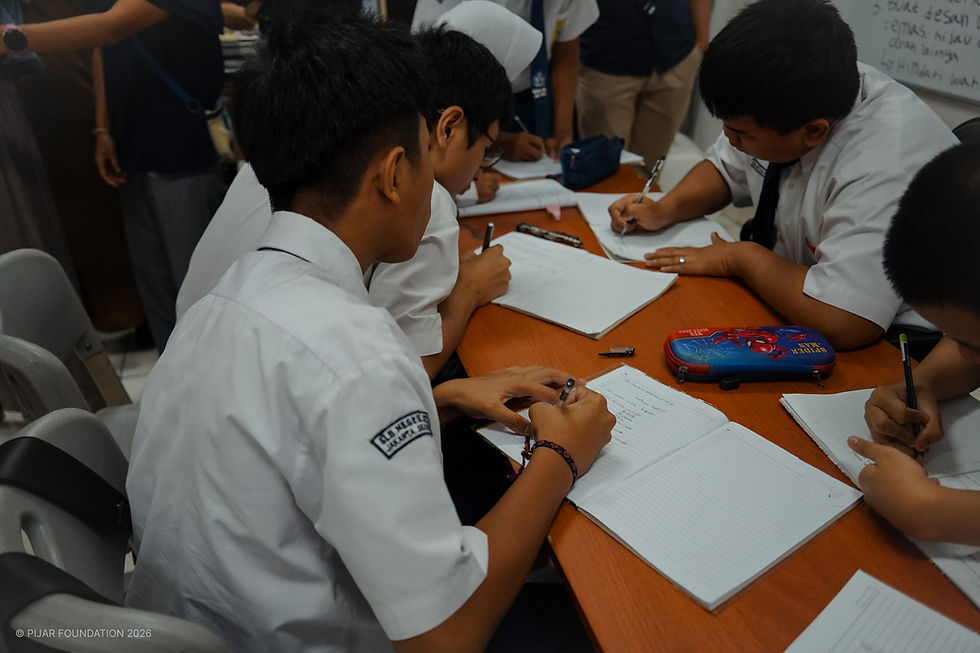
For many children with disabilities in Indonesia, getting an education remains an uphill struggle. Even when they do make it into classrooms, staying in school and getting the support they need to learn can be another challenge.
UNICEF Indonesia reported in 2020 that nearly three in ten children with disabilities had never attended school, citing data from the 2018 National Socioeconomic Survey. At the time, almost 140,000 children with disabilities aged 7 to 18 were out of school. The disparity extended beyond enrolment: only 56 percent of children with disabilities completed primary education, compared with 95 percent of their peers without disabilities.
Progress has since expanded inclusive education, but significant gaps remain. A 2023 study by UNICEF and the National Development Planning Agency (Bappenas) found that, despite a 29 percent increase in the number of inclusive schools between 2020 and 2021, children with disabilities continued to face lower chances of attending and completing school.
The challenge goes beyond the availability of schools. Physical accessibility, limited teacher training, language barriers, insufficient learning support, and curricula that do not accommodate different needs can all determine whether a child is able to participate meaningfully in education.
For children with disabilities, having a place in a classroom does not always guarantee access to learning.
It is within this broader challenge that Pijar Foundation, together with The Nippon Foundation and its partners, has been working to strengthen access to inclusive education, including through the Indonesian Deaf Education Teachers Academy (AGPTI) 2026.
We visited SLB Negeri 2 Jakarta, one of the programme's partner schools, to observe how teacher training and accessible learning practices are being put into action. What unfolded throughout the visit offered a closer look at education beyond enrolment figures, from the role of sign language in helping Deaf students understand lessons to the practical skills that enable students with disabilities to develop greater confidence and independence.
When Language Becomes the Key to Learning
Inside one of the classrooms at SLB Negeri 2 Jakarta, AGPTI participants observed experienced teachers delivering lessons through sign language-based teaching methods. They watched not only how teachers communicated, but also how Deaf students responded to instructions, engaged with the material, and participated in the learning process.
For Deaf children, language accessibility plays a crucial role in how they acquire and develop knowledge. Without communication methods they fully understand, classroom lessons can become another barrier to education, even when teachers and learning materials are available.
This is one of the gaps AGPTI seeks to address. Through a combination of training, classroom observation, and practical learning, the programme supports teachers in strengthening their sign language skills and incorporating them into everyday teaching.
The approach recognises that improving educational access is not simply a matter of bringing more children into schools. It also requires preparing educators to respond to the different ways students communicate and learn.
For Rully Anjar Arifianto, a teacher at SLB Negeri 2 Jakarta who serves as a mentor in the programme, the difference can be seen in how students gradually become more confident expressing themselves.
Known as Pak Rully, he recalls a student who was once extremely shy and believed sign language could only be used in certain situations. "I encouraged him to understand that sign language can be used anywhere, whether during presentations, when meeting friends, or even in interviews," he said.
Over two years, he witnessed a remarkable change. "He developed tremendously. Now, he finds it much easier to interact with anyone, whether they are hearing or Deaf."
The experience highlighted how language can shape more than academic understanding. For his student, becoming confident in communicating also opened opportunities to connect with others and navigate social situations more independently.

Beyond the Classroom, A Different Kind of Learning
The visit also revealed another side of education at SLB Negeri 2 Jakarta.
Away from conventional classroom activities, students were busy making handicrafts, producing batik, and practising screen printing. At a coffee shop run by the school, students prepared coffee that the visiting representatives had the opportunity to taste.

These activities form part of a learning environment where students with disabilities are encouraged to develop practical abilities alongside their academic education.
Making coffee, for instance, involves more than learning to prepare a drink. It offers opportunities to practise following instructions, developing technical skills, taking responsibility, and building confidence through hands-on experience.
For Pak Rully, these are precisely the kinds of abilities that deserve greater recognition. He noted that visitors sometimes express surprise when they discover what students at special education schools can accomplish, reflecting how their capabilities are often underestimated.
"Students in special education schools are taught many different skills. We have abilities that need to be developed, too, but we still lack exposure," he said.
His observation points to a challenge that extends beyond school facilities or teaching methods: the perceptions that shape opportunities for people with disabilities.
Students may gain skills and confidence through education, but support from the wider community remains essential for those abilities to be recognised and developed further.
"Don't be ashamed. We are all equal. We need to show our talents and our confidence," Pak Rully said, sharing a message for Deaf students across Indonesia.
"Everyone needs support, from friends, teachers, and the people around them."
Preparing Teachers to Reach Every Learner
While students' progress can be observed through their growing skills and confidence, much of the work that makes such progress possible begins with teachers.

For Bintang Hardianto, a teacher at SLB Negeri 9 Jakarta and a participant in AGPTI 2026, teaching Deaf students has been a relatively new experience. Having started just a year earlier, he described the satisfaction of seeing students understand what he is trying to communicate.
"When a child understands the meaning of what we are communicating, there is a sense of pride that is difficult to describe," said Pak Bintang.
He also recalled discovering abilities in his students that might otherwise have gone unnoticed. "Behind what people see as their limitations, they have extraordinary talents. One of my students is particularly talented with computers and can even use Excel. They just need guidance and support from the people around them."
His experience has also reinforced the importance of learning from both Deaf and hearing educators, whose different perspectives can complement one another in the classroom.
Such exchanges are central to the practical learning process offered through AGPTI, where teachers can observe different approaches, reflect on their own methods, and strengthen their ability to communicate with Deaf students.
Although AGPTI specifically focuses on Deaf education, its work speaks to a broader challenge facing Indonesia's education system: schools must be equipped not only to welcome children with disabilities, but also to provide learning experiences that respond to their individual needs.
Expanding access without addressing the quality and accessibility of teaching risks leaving students physically present in classrooms but unable to benefit fully from their education.

Making Access to Education More Meaningful
The visit to SLB Negeri 2 Jakarta offered a glimpse of both the possibilities and the complexities of making education more accessible for children with disabilities.
The school demonstrated how different forms of learning can coexist: sign language-based instruction to support Deaf students' understanding, alongside practical activities that help students develop skills, confidence, and independence.
Yet the experiences shared by Pak Rully and Pak Bintang also suggest that progress depends on more than what happens within school walls. Teachers need the appropriate skills and support. Students need opportunities to develop and demonstrate their abilities. And communities need to recognise that disability should not determine the limits of a child's aspirations.
For Indonesia, where children with disabilities continue to face significant educational disparities, our efforts are part of a larger task of ensuring that the expansion of educational opportunities translates into meaningful learning.
These experiences may represent only a small part of Indonesia's broader inclusive education journey. But they offer a reminder that access to education should not end when a child enters a classroom. It should extend to what every child is able to learn, experience, and achieve once they are there.


